The Half-Story
From Amar Kanwar’s films at Serpentine North to being asked where I’m from: an essay on labels, many allegiances and reading the truth in layers.
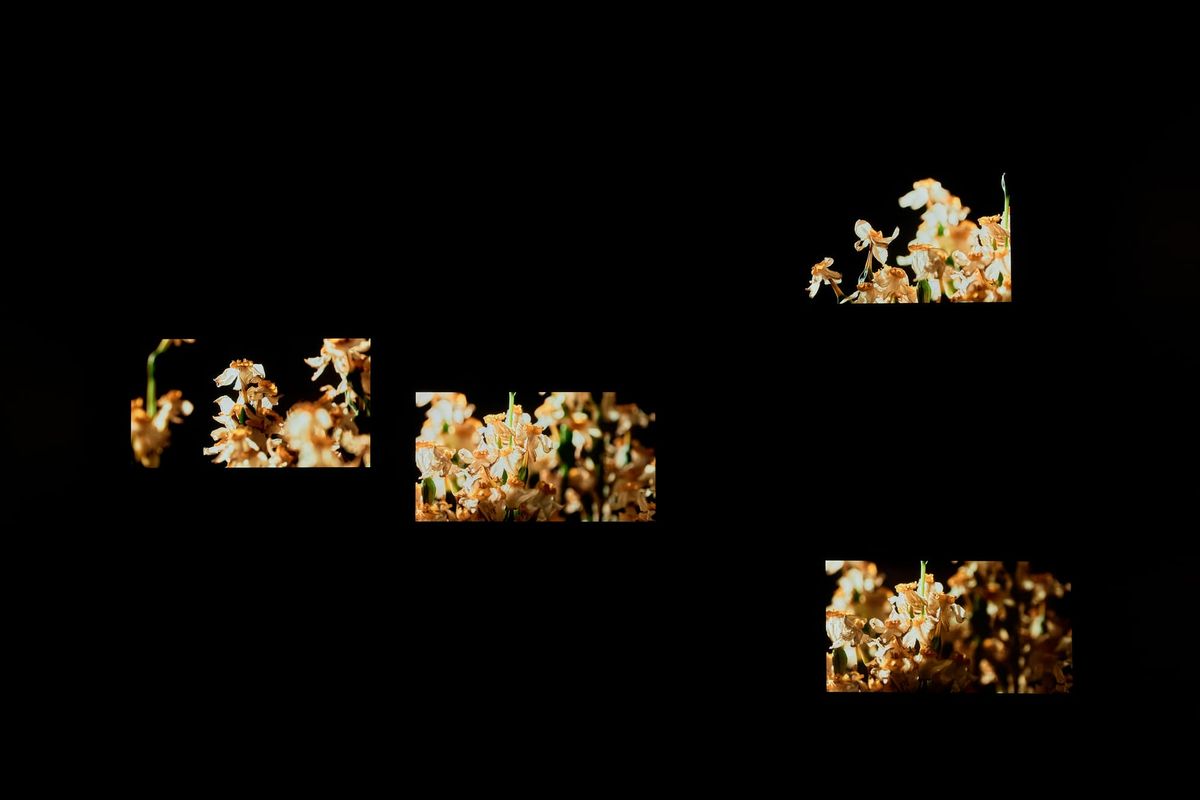
It’s pitch black inside Serpentine North, and it takes a while for my eyes to adjust. I feel disorientated in a space so familiar. The gallery assistant shines his torch on a set of soft stools and motions for me to sit down. Does he sense my unease, I wonder. Slowly the room comes into focus, the moment passes, and I find myself drawn deep into Amar Kanwar’s The Peacock’s Graveyard. Images appear and fade on one screen, then on several, as Kanwar’s texts surface over them. I try to catch as much of the writing as possible, faint in the dark and fainter still without my distance glasses. I sense that these are stories drawn from oral histories, a collage of sorts of ancient folklore and modern tales. And even though on that first screening they only make half sense, I’m drawn to their poetry, at once moving and melancholic.
Kanwar, who was born in New Delhi in 1964 and still works there, has spent more than two decades making films that move between documentary, travelogue and visual essay. His subject is the Indian subcontinent, its histories of decolonisation and Partition, the violence and the displacements, yet the work reaches far beyond its geography. Kanwar looks to the past to make sense of the present, and keeps returning to the same questions: power, justice, memory, and what we do to one another.
The Serpentine exhibition gathers three works into a trilogy: the feature-length Such a Morning (2017), The Peacock’s Graveyard (2023) and The Charcoal Man (2026), a new installation made over three almost reclusive years of research, filming, writing and listening. Kanwar’s own words for the exhibition sound like one of his films: “Our capacity for evil is not new and yet the last decade has twisted this knife deeper into our souls… I cannot remember anymore, said the patriot to the traitor. For I have forgotten what I have forgotten. That’s not a problem, he replied, as I have forgotten too.”
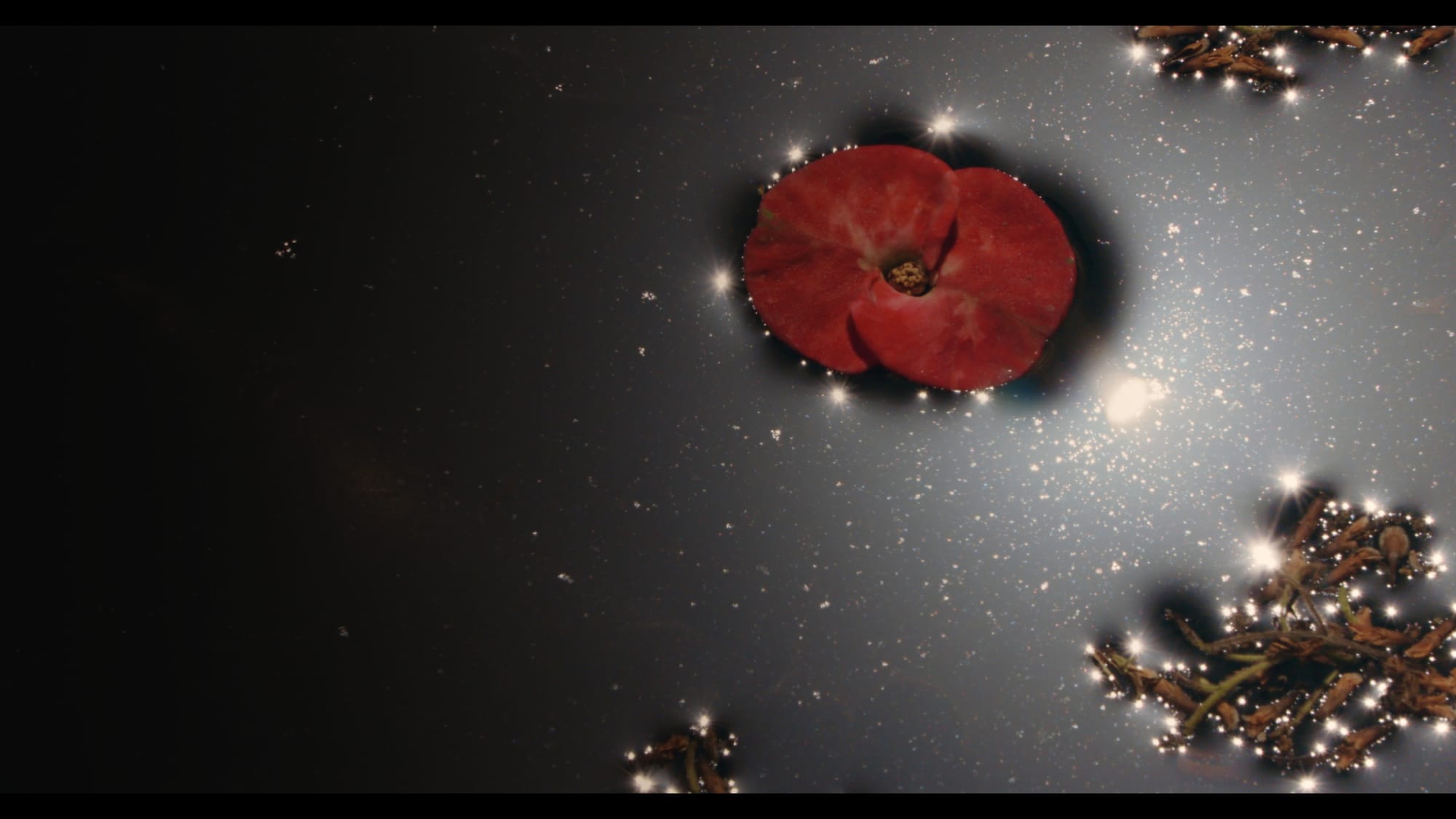
The Peacock’s Graveyard is a set of fables about responsibility, ethics, dignity and loss. Kanwar, perhaps surprisingly given my initial reaction, describes it as “not a lament or mourning, but perhaps a kind of gift, a collection of stories, some ancient, some new, something to keep by one’s side every day, or take along if going someplace.” The stories, he adds, “lay the groundwork for reflecting on our unbearable arrogance, delusions and deep desire for violence.”
I leave the hushed darkness of the Serpentine and step into Hyde Park, full of light and deep in autumnal glory, with flashes of reds and oranges and yellows and greens bouncing off one another as I make my way home. The melancholy of Kanwar’s films and the brilliance of nature sit together, neither cancelling the other out. Even the leaves, at their most vivid, are on the turn. I stray from the path to walk through them.
Against a worldview of certainties, one that leaves no patience for holding multiple truths, Kanwar’s art offers a different way of seeing. His films refuse to settle. Stories begin and break off, images drift across screens without telling us where to look, and the questions they raise stay with us long after we leave the darkness of the gallery.
Kanwar has called this the “half-story”. It sounds simple enough, but in an age that fetishises concrete answers, that wants its truths in black and white and has no time for anything longer than a few seconds’ reel or a social media soundbite, it strikes me as a radical idea: that some truths can only be approached in fragments, and that what is left unfinished is where our own thinking begins. I believe in facts, and in truth. What I am arguing for is the openness to read them in layers, to accept that the same truth can be lived, remembered and understood in more than one way. I think of Kanwar’s insistence on the grey areas and the uncertainties, and of how urgent this feels now, when so much of public life asks us to name a single allegiance and to judge everyone else by theirs.
Art, I remind myself, skipping through the fallen leaves and the puddles left by recent rain, has the power to hold these multiple truths. Holding more than one truth at once is something I learnt early, and out of necessity.
Where are you from
I cannot overstate how often I am asked where I’m from, asked, in other words, to identify myself. “London,” I say, to which inevitably comes a follow-up, “but where are your family from?” or “you look like…”. Never mind that I was born in England and spent a mere eight years of my childhood in Iran and, as far as I know, sound like any other Londoner. These questions are seldom meant in malice; they are born out of curiosity but also the need to place a person as a way of understanding them better. “Ah, you are Iranian. That explains. I once had a friend who was from Iran but she called herself Persian. It has a beautiful ring to it,” they may say, without irony. I try not to delve into the complexities of why Persian should sound so much more beautiful than Iranian.
Uber drivers will often glance into the rear-view mirror and ask if my name is Muslim. The question here may come with a heavier note and, depending on what I’m wearing or whether my white English husband is with me, perhaps a little judgement. I shrug and say, “No, it’s Persian for the narcissus flower.” Even I reach for a label when cornered.
I learnt early how quickly people are labelled. At 13, a few months after we had fled Tehran via the mountains of Kurdistan, my sister and I arrived at a state school in north London with no record of our grades and English that had grown rusty since our childhood here. A few minutes’ interview was enough to decide our places. My sister, a straight-A-plus student, was sent to the bottom class; I, also an A student, was sent to Special English, a prefab in the yard where a handful of children from India, Ghana, France were taught together.
There I watched in horror as our elderly teacher directed explicitly racist remarks at Ruth, a shy girl from Ghana. Ruth looked down in silence as the rest of the class, perhaps embarrassed, perhaps afraid, looked away. I had been in the country only a few weeks. I had no friends there, no standing and little English, but I knew what I was hearing. I stood up and, in the few muddled sentences I could string together, told the teacher exactly what I thought of her. I can still recall the heat on my cheeks and the tremor in my voice. The room fell silent as I packed my belongings and walked out. That day I was allowed back into the main building, and before long my sister was moved up too.
The following year, a group of South Asian girls invited me to join their side of the form room. It was Preeti, the leader of the pack, who sent her girls to ask me to eat lunch with them. I wasn’t Asian, nor did I speak their language, and I wondered whether I had been chosen for the colour of my skin. I had grown up first in England, then in Iran, among friends from all over, and I didn’t want to be told where to sit. When I drifted away, the friendship quickly soured. They would snigger whenever we crossed paths in the corridor, and made it clear they thought I saw myself as white. I learnt my lesson there and then: never to commit to a single tribe.
Many allegiances
In 1998 the Lebanese-born French writer Amin Maalouf published Les Identités meurtrières, known in English as In the Name of Identity. Since leaving Beirut for Paris in 1976, he writes in the book, people have asked him whether he feels more French or more Lebanese, and his answer is always the same: both. Identity, he says, is made of many allegiances, to a language, a faith or none, a family, a city, a trade, a set of tastes, and no two people hold quite the same combination. The danger begins when we are asked to choose just one, and to treat it as the whole of who we are. It is that narrowing, he argues, that has fuelled the darkest chapters of history. Hannah Arendt, who fled Nazi Germany, knew first-hand where it leads.
Their thinking is close to my own. I see race as a construct rather than a science, and identity as fluid and many-layered. I’m interested in society, in how people think and act, and in what the arts can be within it: their position, their power, their possibilities, their responsibility.
Labels, even well-meant ones, narrow us. They narrow our views and limit our possibilities. Like many from my background, I’m often asked to write about the Middle East and its artists, on the understanding that I will know the region better. That is true to a point, though it is hardly all I can do. Artists, too, are seen through the prism of their identity, and there is a deep irony embedded in it: inclusion, a good intention, hardens into categories that expect artists to perform their origins. As an art writer I see it often: artists are asked, or tasked, to speak for the place they come from, or to make work in the form expected of them. You see the labels and the tribes forming at art events and biennales, and you sense the unease when a work doesn’t fit within that framework.
But there is hope here too. The arts can hold what documents, data and political slogans can’t. Kanwar’s new work, The Charcoal Man, marks 80 years since the 1947 Partition of India, which divided the subcontinent and set off one of the largest and most violent migrations in history. Across seven screens, archival material sits alongside memory, image and invented story, fact and fiction side by side, as Kanwar tries to “seek coherence from disintegration, insight from fusion and stories within stories.” Official histories give us the dates and the figures; the work adds what they leave out, something closer to how we actually remember.
I grew up with this way of seeing without knowing it. My grandmother recited Hafez, reaching for her worn copy of the Divan, which followed her all over the world, from London to San Francisco and Tehran, on her annual pilgrimage to visit her children. Hafez’s verses are so open to interpretation that Iranians still turn to the book at random for guidance, each reader finding their own meaning in the same lines; in many of our homes it is more sacred than any religious volume. Nobody expected a poem to give a single answer.
William Kentridge has said that art gives a sense of agency in the world, for the person making it, as well as the viewer, and it’s a line I return to often. Collage, a medium I use in my own artwork, offers a way of understanding the world as fragments, and of celebrating its possibilities.
When I met the South African artist at his Yorkshire Sculpture Park exhibition last year, I asked if he had hope in a world that feels increasingly dark and difficult to digest. “I have both hope and pessimism, both running together,” he replied, matter-of-factly. “I think to have only one or the other is to blind yourself to part of the world and say, everything can only be a disaster. It blinds you to many things that are happening. And to say everything’s for the best, blinds you to disasters that are very, very present.” He is interested, he told me, in “moments of clarity, but ones that don’t pretend to last.”
I return to the Serpentine a few days later to sit through The Charcoal Man. Images and texts drift across the screens in no fixed order, and through them moves the charcoal man, a shadowy figure who, Kanwar has said, “is omnipresent and recycles across histories and geographies”. He is not violent, nor only a trickster, yet he “has a power over us”. Whether he is real or imagined, I leave the gallery sure that what matters, as T.J. Demos writes in Frieze, is how we respond to him.
This is what Kanwar has been asking of us all along. Multiple screens at once, image and text, moving and still, the archive beside the fable: we cannot take it all in, and he never asks us to. We choose where to look, look away and then look again, and slowly learn to hold several things in view without needing one to cancel out the others. It is how I would like to hold the many truths of who we are, and of who others are, too. Outside, the park has shed more of its leaves since my last visit, the colours scattered underfoot, and I walk through them again.
Nargess Banks, 29 October 2026, London
Amar Kanwar is at Serpentine North, London until 27 January 2027