Story Keepers
My grandmother’s stories of kings, prophets and magic, told beneath a hazelnut tree in Damavand, taught me that memory lives in the retelling. Three painters, Angel Otero, Mónica Pérez and Jun Martínez, carry that same work into paint.

My grandmother told stories. My mother’s mother spun magical tales of kings and queens and princesses, of prophets and wise men, of fairies and demons and magic carpets, drawn from the Persian classics. Sitting beneath the hazelnut tree, our treehouse hovering above, in our bagh in Damavand, with its dilapidated house and the stream at the bottom of the hill, she recited from Hafez and Mowlana (Rumi) and, occasionally, Saadi. From the age of nine until I was 13, she was also my unofficial tutor, unwrapping the metaphors and meanings of these complex texts for my studies.
She relived her own childhood too: the call at dawn from her father, my great-grandfather, to mount their horses and ride into the mountains of Savadkuh. Before they set off, the cook would prepare plain rice, kateh-style so it was a little soft, served with thick strained yogurt and washed down with tea, a sugar lump dipped in and sipped for sweetness. She told again and again how, as her father’s first and favourite daughter, she was his chosen companion on these rides.
The images were so vivid that I could smell the butter and salt in the kateh, taste the sour yogurt softening in its heat, and the floral, saffron-scented tea. I saw my grandmother, aged nine, ten, eleven, riding fast alongside her hero, her father, strong and fearless, a warrior in her eyes, and in mine. I could see the vast valleys, green and lush and punctuated with wild flowers: white, purple, pink.
My father’s father had a different repertoire. His tales, told in our north London flat after we had left Iran and returned to England, where I had spent my early years, were of his own great adventures: epic, colourful and wild, with more than a hint of fantasy, repeated over and over and more exhilarating with each telling. For me, a young teenager working out who I was in a place I half remembered, having left a world behind, these stories were a bridge to the past, to their past, a past that was long gone, a past that perhaps never really existed, except in my grandfather’s vast imagination. Later, studying art, I had even more time to listen: my grandfather often sat for my life drawings, talking as I drew.
There were the railway stories from the time he came to Manchester to advise on the new tracks. They conjured a grey, dusty post-war England, rationing still in force, a country struggling to get back on its feet. And they sketched a young engineer, newly married to his childhood sweetheart, given the chance to see another world: weekends in London, walks in Regent’s Park, a month’s salary spent on a pair of brown crocodile boots from Russell & Bromley that my grandmother had admired in a window on Bond Street.
His tales often featured food; my grandfather loved food in all its forms. One involved a train journey from Arak to Tehran, and 50 boiled eggs bought on a whim from a vendor on the platform for his mother, my great-grandmother. En route, feeling peckish, my grandfather cracked one egg on his broad, by then bald, head and sprinkled it with salt from a bag in the package. It tasted wonderful. He took another (no one would count the eggs, after all), cracked, salted, ate. Then another. By the time the train pulled into Abadan, only three eggs remained. So he cracked them open too, added the salt, ate, and was sick for a week. He would recall these memories with a mischievous chuckle, always as though he were telling them for the first time.
Later, when I was grown up and my father had become a grandfather and my mother a grandmother, they too would weave tales of their past: the grey cold of a British boarding school, London in the sixties, adventures in Shiraz. We, and later my nieces and nephew, listened in awe. My father’s circle styled themselves after Alain Delon and Jean-Paul Belmondo, while he favoured the Dirk Bogarde look. Of his many tales, I loved hearing of their trips to Paris on weekends, entertained by my father’s young uncle Abol-Fazl, a notorious rascal and womaniser with the looks of Orson Welles. On one trip the group spotted a beautiful fair-haired woman on the Métro and talked about her freely in Persian, only to discover, mortified, that she was Iranian. From then on, photo became their code word, a whispered warning whenever they passed fellow countrymen in the street, so no one would say anything rude. My father chuckles every time he tells this one, and I hear my grandfather.
My mother often recalled her early years in London, when she lodged with my father’s sister, Mina, in Kensington. She spoke fondly of that time and the sheer freedom London offered, a world away from the constraints of her childhood in Tehran and her strict father. A favourite story was of a late-night trip to the air terminal on Cromwell Road by Gloucester Road, where passengers checked in before taking the coach to Heathrow. Mina had a craving for Cadbury’s Fruit & Nut, so out they went in their pyjamas, and no one batted an eyelid.
There were stories, too, of my father’s time in Shiraz as a young doctor treating patients without charge, and of his visits to the Qashqai, the nomadic tribes who moved their flocks with the seasons between the mountains and the plains of Fars. He described their goat-hair tents, and the women in their layers upon layers of colourful skirts, weaving rugs in vivid hues. Their floral patterns were carried in memory alone, through songs and sayings passed from mother to daughter, for these dusty paths had no such flowers to speak of. And there was always tea and bread, and yogurt from the herd, offered to the visiting doctor.
Through these tales we came to know worlds we would never see for ourselves. And it was these stories, fiction or otherwise, that became my keepers of history. Those wise men, Hafez and Mowlana, made sense of our world across the centuries; it was the storytelling, much of it carried by the women in my family, those anecdotes and vignettes and memories passed down from generation to generation, that kept history alive, and still does, breathing life between the silences.
Memory keepers
Elif Shafak speaks of novelists as memory keepers. Can art, too, be a vessel for storytelling, with the artist as keeper of memory? And can a painting, built up in layers, hold layered histories?
Angel Otero, born in Puerto Rico and long based in New York, paints the island from a distance. He treats paint as a physical material, building it up, scraping it back, and peeling whole skins of oil paint from glass to recompose them on canvas. Faded family photographs drift in and out of his surfaces; so do the rooms of his grandmother’s apartment, its gate locked since she died. Otero holds two versions of his godmother’s final days and keeps both, a “double exposure”, as he put it when I met him at Hauser & Wirth in Somerset, where he was completing a residency, of what happened and what we choose to remember. It is the logic of the family story, fiction or otherwise, laid down in paint.
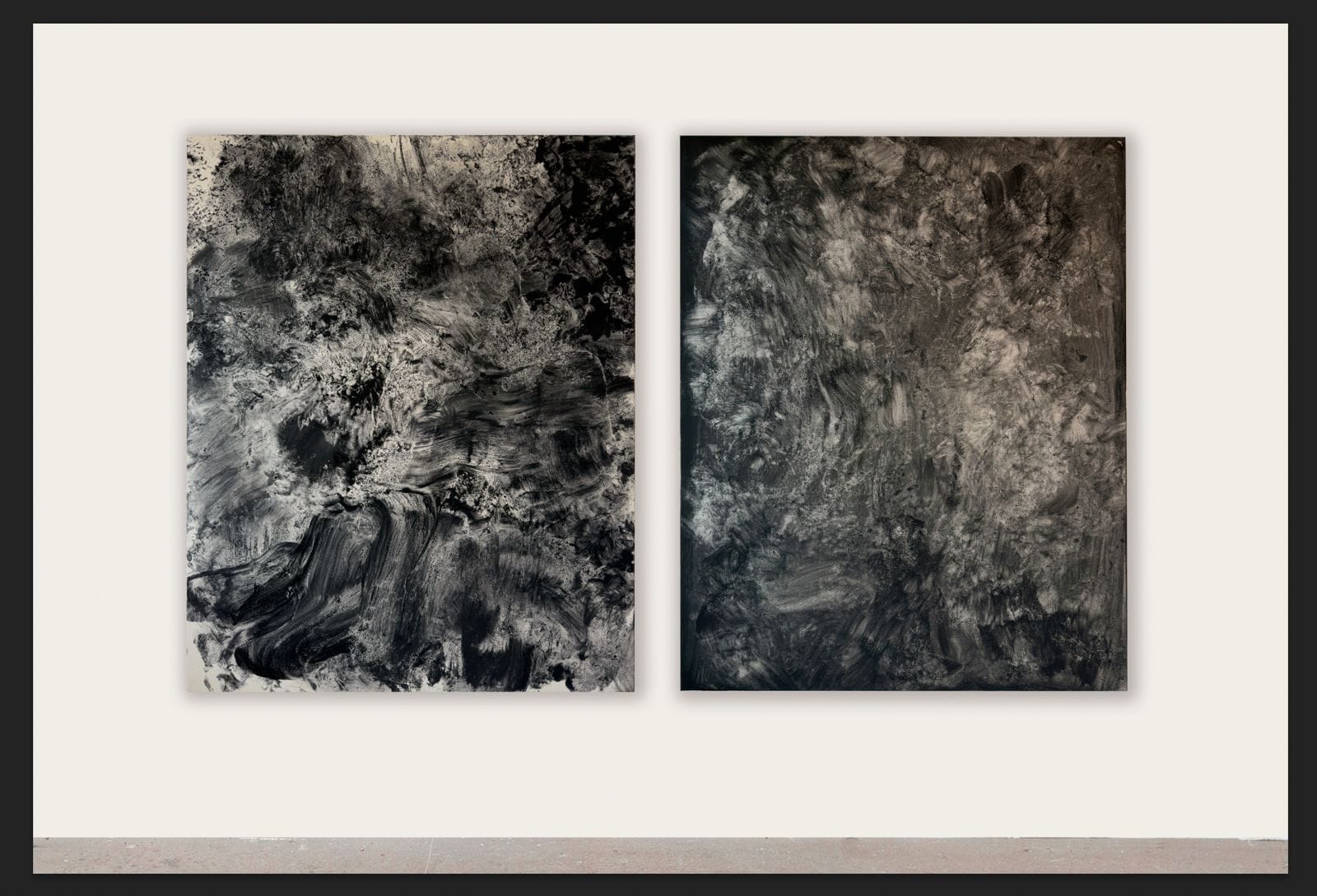
For artists earlier in their careers, the layers are being laid down now. Mónica Pérez is a Uruguayan artist temporarily living in London with her family as she completes her postgraduate studies at the Royal College of Art. Pérez uses her work to unweave the loose threads between the two countries: the history of Uruguay’s grasslands and the livestock economy that once bound its agricultural wealth to industrial Britain. “Living here, I wanted to understand the relation between the two countries and see the links,” she told me at Paraíso, the new London art fair dedicated to Latin American art, where she was exhibiting with Cecilia Brunson Projects.
Pérez makes her own materials, pigments from elements gathered in Uruguay: Garzón clay, bone black, raddle and industrial wool residue. These are energetic, layered paintings that she returns to again and again, often laying raw canvas out on her studio floor, working and reworking the materials, using her body as a tool and allowing the process the freedom to form the work. Through them she examines the systems of marking, counting and control embedded in that history.
Hers is a constant revision: of her memory of Uruguay, her knowledge of history, her relation to England, to London, its light, its people. If novelists are memory keepers, as Shafak suggests, Pérez keeps memory in the very matter of her paintings: the clay of home, the wool and bone of the trade that once bound Uruguay to Britain, reworked layer by layer until the history surfaces.
I met Puerto Rican artist Jun Martínez at Frieze London, where he was also showing with Cecilia Brunson Projects. His paintings document the environment and are shaped by observation and memory; these are immersive works that sit comfortably between landscape and abstraction. Martínez came to London to study at the RCA. Now three years into life here, he recalls the trees, flowers and textures of Puerto Rico largely from memory, and by revisiting his earlier works. “I came to London after eight years of practice in Puerto Rico where I was mostly painting outside,” he told me. “And now I’m still attached to painting my Puerto Rican landscapes, but from a distance, and learning really what that means.”
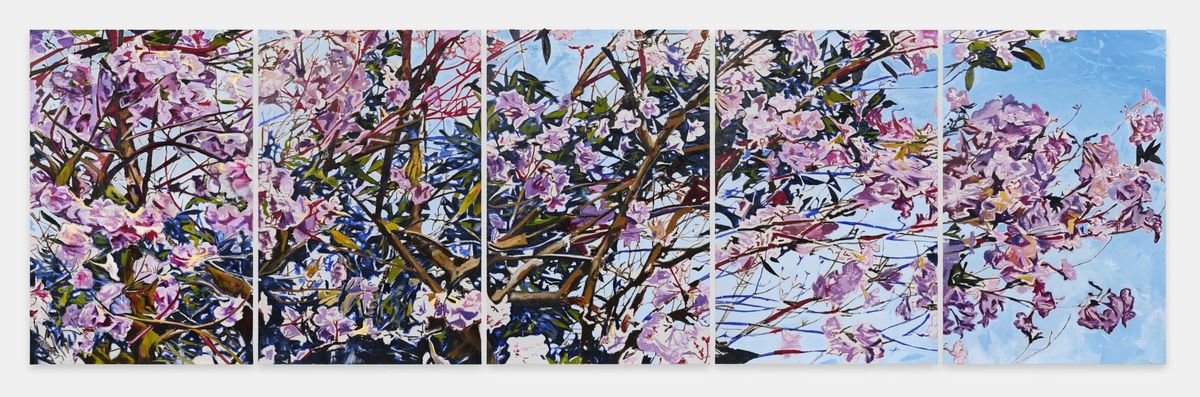
On exhibit at Frieze was Martínez’s pentaptych of the roble blanco, or Tabebuia heterophylla, a native tree celebrated for its canopy of pink and white blossom and planted everywhere as an ornament outside homes. “We had one outside our home,” he said as we surveyed the work. So familiar was it that he barely knew it. “Once I stopped seeing it, I was like, I want to know more about this thing I don’t have with me anymore. I started researching this tree that I grew up seeing daily, and learned so many amazing things of how important it is for reforestation, for the ecosystem, for the soil, for the renewal of the land.”
The tree began to take on new meaning, its power to reforest pointing to survival and renewal. Martínez spoke of Puerto Ricans insisting on staying alive through natural and political disasters alike. On an island whose past and present have been shaped by its relationship with the United States, this native tree, a survivor disguised as an ornament, becomes in his paintings a symbol of resilience and a way to reimagine a place.
Politics runs through the colour, too. The blue of the Puerto Rican flag carries its own history: a light sky blue for those who seek independence, a darker blue, matching the American flag, for those who want to be fully part of the United States. In this work the blues sit together, “embedded”, said Martínez, holding the complexity of a people who want different things. “I’m not judging.”
Martínez paints from photographs, returning to the same image he first worked from three years ago. He showed me the earlier version in the catalogue. “At that point, I was just amazed by the pink flower. And now it’s something else.” The source stays the same; distance, time and memory alter what he sees. He described it as “a nostalgia towards the future”: looking at the old places as they are now, letting the landscape transform. For Martínez, landscape is a living archive, and the roble blanco a carrier of memory.
Martínez repaints the same photograph and finds something else. Pérez reworks the same canvas, layer upon layer. I read Hafez and Mowlana and layer my grandmother’s interpretation with my own, an understanding shaped by my own stories, my own age and experiences. My grandfather long gone, I retell his tales, adding my own layers, my own memory of the telling. My nieces and nephew whisper photo whenever we pass another Iranian in London. We all become memory keepers.
Nargess Banks, 18 October 2026, London
